

South Suburban Apartments: I-35 Corridor Living — Buda, Kyle & San Marcos
Most affordable rents in the metro, with concessions stacking on top. I match you to the best deal for your budget and commute — free to renters.
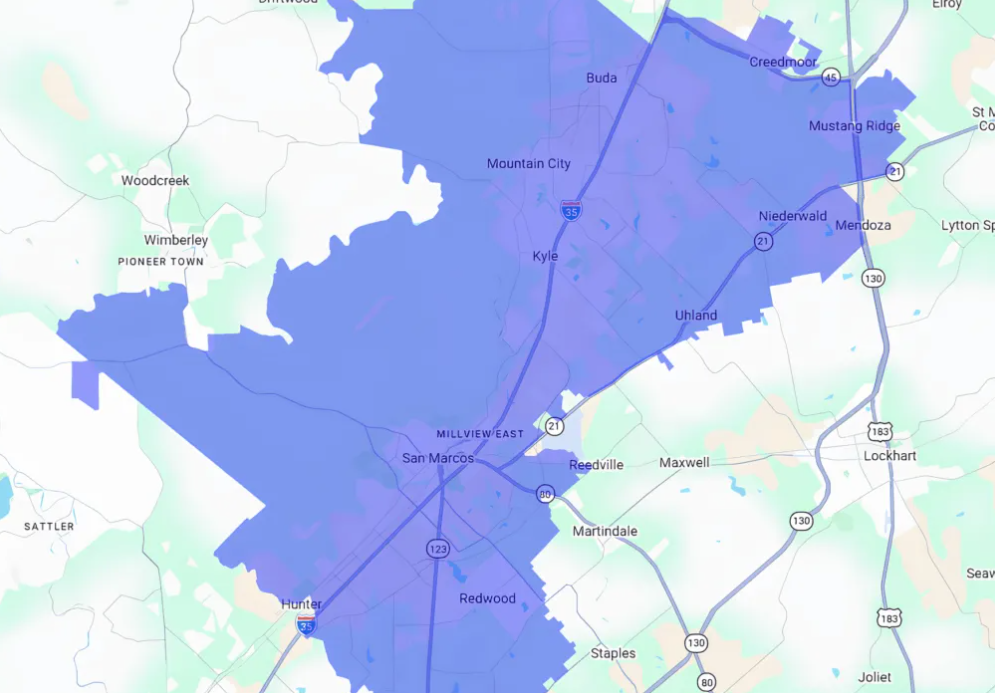
Austin’s rental market dropped ~20% from its 2022 peak, but the real opportunity is 20-30 minutes south along I-35. I’ve toured 500+ Austin-area apartments over the past few years, and the South Suburban corridor (Buda, Kyle, and San Marcos) offers the best combination of new construction, affordability, and lifestyle quality I’ve seen anywhere in Central Texas. These aren’t distant exurbs requiring 90-minute commutes. You’re getting 2024 construction at prices that match 2019 Austin, with master-planned communities, top-rated schools, and genuine small-town character that’s disappearing inside the Loop.
The math works. While downtown Austin 1-bedrooms start at $1,800+, you’ll find Class A properties in this corridor from $975-1,430 for similar square footage. The trade-off isn’t quality: it’s commute time and nightlife access. If you prioritize space, value, and community over walking to food trucks at midnight, this corridor delivers. I’m working with 40% more clients here than two years ago, and the migration pattern is clear: Austin renters priced out of 78704 and 78745 are discovering that Buda feels more like old South Austin than South Austin does.
Here’s what I tell clients: the South Suburban corridor isn’t for everyone. You need a car. Your friends might not visit as often. But you’re getting high-quality amenities at mid-range prices, actual parking spaces, dog parks that aren’t overcrowded, and communities where management companies compete on service, not just location. I’ve tracked every major rent decline and concession cycle since 2019, and right now (February 2026) these communities are offering 6-12 weeks free with screening flexibility that disappeared from Austin proper years ago. Check current move-in specials for the latest deals.
What to Expect in South Suburban Austin
Cost
Studios: $987+
1 Bedrooms: $975+
2 Bedrooms: $1,430+
3 Bedrooms: $1,599+
Parking: Usually included (major advantage over Austin)
Market Stats
- 15 Featured Communities
- Rent Floor: $975+ (Kyle)
- Sub-Areas: 3 cities along I-35 South
- Commute to Downtown: 25-40 minutes
- New Construction: 60%+ built since 2020
Quick Comparison: South Suburban Areas
| Area | Character | Rent Range | Commute | Known For |
|---|---|---|---|---|
| Buda | Small-town charm, outdoor focus | $1,010-1,447 | 30-35 min | Parkland, newer construction, quiet setting |
| Kyle | Master-planned, fastest growing | $975-1,430 | 25-30 min | Walkable retail, best commute access, variety |
| San Marcos | College town, river recreation | $819-1,380 | 35-40 min | River access, lowest rents, dining variety |
Which Sub-Area Fits You?
- Prioritize quiet and outdoor access? Buda has the most parkland per capita in Texas and the smallest, newest apartment inventory. You’ll pay a bit more, but the community feel and property quality justify it.
- Prioritize commute time and variety? Kyle sits closest to Austin with the most apartment options across every price tier. Master-planned development means walkable retail is actually within reach.
- Prioritize budget and lifestyle? San Marcos delivers the lowest rents in the corridor plus river recreation, a college-town dining scene, and nightlife that Kyle and Buda can’t match. The trade-off is a longer drive to Austin.
- Need screening flexibility? All three cities have properties with 150% income requirements and case-by-case credit review. Kyle and San Marcos offer the most options for renters with broken leases or past evictions.
Buda: Small-Town Charm Going Suburban Fast
Buda calls itself the “Outdoor Capital of Texas” — it has more parkland per capita than any other Texas city. After touring properties here monthly for three years, I believe it. This isn’t marketing speak. Buda genuinely feels different from typical suburban sprawl. Main Street still has character, the annual Wiener Dog Races draw thousands, and you can walk most neighborhoods without feeling like you’re in a subdivision maze.
The apartment market here is newer and smaller than Kyle or San Marcos. Most properties opened since 2020, so you’re getting current finishes (quartz counters, vinyl plank flooring, smart locks) in layouts built for how people actually live now. Property management is more personal. I know leasing agents by name, and they remember my clients. The downside? Fewer options and higher average rents. But the quality-to-price ratio works if you value community feel over urban amenities.
Buda’s positioning between Austin and San Marcos gives it geographic advantages. You’re 20 minutes from Austin-Bergstrom Airport, 15 minutes from the San Marcos outlets, and close enough to South Austin that weekend trips feel natural rather than planned expeditions. The city is growing fast — population doubled in the last decade. But it’s managed growth with actual planning, not the free-for-all you see in other suburbs.
Junewood
Pros
- Brand new construction (2024) with quartz countertops, smart home features, and energy-efficient appliances
- Floor plans from 855-1,801 sqft with high ceilings and full-size washer/dryer
- Large pool, modern fitness center, and dog park with washing station
- Professional management with strong maintenance response times
Cons
- Higher rent range ($1,345-2,800) puts it at the top tier for the area
- Limited availability: only 18 months old, so units turn over slowly
- Parking can be competitive during peak leasing season
Overall Thoughts
Junewood works for renters who have budget flexibility and want the newest construction in Buda. You’re paying more, but you’re getting 2024 construction standards: quartz countertops, smart home features, and energy-efficient appliances that actually reduce your utility bills. The 1,800+ sqft 3-bedrooms are genuinely roomy, not the cramped “3-bedroom” layouts you find in older Austin properties.
The management company handles maintenance requests well, which matters more than most renters realize until something breaks. I’ve had clients here for 18 months with zero major issues, and the few service requests were handled within 24-48 hours. The 8-weeks-free concession brings the net effective rent to $1,139/month on a 1-bedroom ($1,345 base × 0.8466 on a 12-month lease). That’s competitive with aging Austin properties offering half the space.
Mansions of Buda
![Photo: Grand entrance with landscaped grounds and luxury apartment facades]
Pros
- Floor plans up to 2,739 sqft. Some of the largest apartments in the corridor
- Full amenity package: large pool, well-equipped fitness center, and clubhouse
- Strong concession package (up to 10 weeks free on 14+ month lease terms) makes the pricing more accessible
- Pet-friendly community with large dog park and pet washing station
Cons
- Higher pricing ($1,328-2,790) targets higher income brackets
- Newer community (2023) still building full resident base and community culture
- Limited public transportation options; car essential for all errands
Overall Thoughts
The Mansions lives up to its name with floor plans that feel like small houses rather than apartments. The 4-bedroom units at 2,700+ sqft are larger than many Austin homes and cost less than a comparable rental house. This property works for renters relocating from expensive markets who want to maximize space for their dollar.
The 10 weeks free concession is aggressive. It brings a $1,600/month 1-bedroom down to a net effective $1,293 ($1,600 × 0.8082 on a 12-month lease). That’s strong for 2023 construction with high-end finishes. The trade-off is location isolation; you’re committed to driving everywhere. But most residents I’ve spoken with prefer the quiet suburban setting over urban convenience. The community is building good social dynamics with regular resident events and well-maintained common areas.
The Luxe of Buda
Pros
- Brand new 2024 construction with latest design trends and energy-efficient features
- Competitive pricing ($1,350-2,953) with strong value for brand-new construction
- Full amenity package including pool, fitness center, and community spaces
- Flexible screening criteria and multiple lease term options
Cons
- Still in lease-up phase, so some amenities and community programs are developing
- Limited long-term resident reviews available due to recent opening
- Higher-end units approach top-tier pricing without all the finishes to match
Overall Thoughts
The Luxe represents the new standard for suburban apartment development: current design, smart home features, and amenity packages that compete with urban high-rises. The 2.5 months free concession is substantial and brings pricing into competitive range with older Austin properties.
What I appreciate is the variety of floor plan sizes. The 750 sqft 1-bedrooms feel roomy compared to Austin’s increasingly cramped layouts, and the 2,100+ sqft 4-bedrooms provide legitimate house-alternative living. Management is responsive during the lease-up phase. That doesn’t always continue once properties stabilize, but early signs are positive based on my clients’ experiences.
Prose Buda
![Photo: Community entrance and leasing office with modern landscaping]
Pros
- Solid value with 2023 construction at mid-range pricing ($1,099-1,520)
- Strong concession package (up to 10 weeks free) creates a low net effective rent
- Smaller community size promotes neighborhood feel and personalized management
- Good floor plan variety from studios to 2-bedrooms
Cons
- Fewer amenities compared to larger properties in the area
- Smaller unit sizes may feel tight for families or remote workers needing home office space
- Newer community still establishing resident culture and long-term management patterns
Overall Thoughts
Prose hits the sweet spot between price and quality that I recommend for most clients in this area. The 10 weeks free brings a $1,200 1-bedroom down to a net effective $970 ($1,200 × 0.8082 on a 12-month lease). That’s strong value for 2023 construction. You’re getting current finishes, in-unit washer/dryer, and professional management at prices that compete with aging Austin properties offering less space and fewer amenities.
The community size works in your favor. Management knows residents by name, and maintenance requests don’t get lost in corporate bureaucracy. I’ve worked with several remote workers here who appreciate the quiet environment and reliable internet infrastructure. It’s not top-of-market living, but it’s quality living at a price that leaves room in your budget for other priorities.
Kyle: Master-Planned Growth Done Right
Kyle ranks among the fastest-growing cities in the U.S. (second only to Georgetown among cities with 50,000+ residents in 2023 Census data) and it shows in the apartment landscape. Unlike sprawling development that feels random, Kyle’s growth follows master-planned community principles with designated commercial areas, preserved green space, and infrastructure that mostly keeps pace with population growth.
The apartment market here offers the most variety in the South Suburban corridor. You’ll find properties rivaling Austin’s top-tier communities alongside solid mid-range options that prioritize value over flash. Kyle’s location gives it the best commute access to Austin: 25 minutes to downtown, 15 minutes to South Austin employers. All while maintaining suburban amenities and pricing.
What sets Kyle apart is the planning infrastructure. The city requires developers to contribute to parks, schools, and transportation, so growth doesn’t feel chaotic. You have actual sidewalks, connected trail systems, and retail development that serves residents rather than just capturing highway traffic. The Plum Creek area shows this approach well, with multiple apartment communities integrated into broader neighborhood planning.
Arden at Kohlers Crossing
Pros
- Strategic I-35 location provides strong Austin commute access
- Strong concession package (up to 10 weeks free) with competitive base rents
- New construction (2024) with current finishes and energy-efficient features
- Flexible lease terms and screening criteria accommodate various renter profiles
Cons
- Highway proximity means some traffic noise, especially in units facing I-35
- Still in lease-up phase with amenities and community programming developing
- Limited long-term resident feedback available due to recent opening
Overall Thoughts
Arden represents the value play in Kyle’s top segment right now. The 10 weeks free concession brings a $1,400 1-bedroom down to a net effective $1,132 ($1,400 × 0.8082 on a 12-month lease). That’s competitive with older Austin properties offering less space.
I’ve toured the property multiple times and been impressed with the construction quality and floor plan efficiency. The 1-bedroom layouts feel larger than their square footage suggests thanks to high ceilings and smart design. Management is proactive about resident concerns during the lease-up phase. How service levels hold up once the property stabilizes is the open question. But so far, signs are good. For renters who want new construction and commute convenience, this is a strong option.
The Chloe
Pros
- Good value with 2021 construction quality at competitive pricing ($1,125-1,964)
- Generous concession package (up to 6 weeks free) drives down net effective rent
- Flexible screening criteria (150%) accommodates renters with credit or rental history issues
- Well-established community with proven management track record and resident satisfaction
Cons
- Floor plans trend smaller than competitors, may feel tight for larger households
- Amenity package is solid but not extensive: pool, fitness center, basic clubhouse
- Increasing popularity means less availability and potential rent increases at renewal
Overall Thoughts
The Chloe has become my go-to recommendation for clients who want quality suburban living without top-tier pricing. The 6 weeks free concession is solid. It brings a $1,125 1-bedroom down to a net effective $996 ($1,125 × 0.8849 on a 12-month lease). For 2021 construction with professional management, that’s hard to beat.
What I appreciate most is the screening flexibility. The 150% income requirement and case-by-case credit review help renters with non-traditional backgrounds or temporary financial setbacks. I’ve worked with clients here who had credit scores in the 600s and complex rental histories. Those are situations that would auto-decline at stricter properties. The community has maintained good condition and resident satisfaction over three years, which tells me the management practices are solid for the long haul.
Opal Point at Kyle
Pros
- Competitive pricing ($1,000-2,772) with strong value for 2023 construction
- Good concession package (6 weeks free) and flexible lease terms
- Current floor plans with efficient layouts and modern finishes
- Growing community amenities and resident programming
Cons
- Fewer high-end features compared to top-tier properties
- Smaller floor plans may not accommodate larger furniture or home office needs
- Community still developing full identity and resident culture
Overall Thoughts
Opal Point offers the best entry point into Kyle’s newer apartment market. Starting at $1,000 for quality 2023 construction is hard to find in today’s market. The 6 weeks free brings the net effective rent down to $885 ($1,000 × 0.8849 on a 12-month lease). That competes with older Austin properties in less convenient locations.
The floor plans are efficiently designed, though not large. The 1-bedroom units work well for singles or couples without extensive furniture or home office requirements. I’ve had good results working with first-time renters and young professionals here. People who prioritize location and affordability over top-end amenities. Management is building positive community culture with resident events and responsive maintenance service.
San Marcos: River Town with College Energy
San Marcos balances college town energy with river recreation and outlet shopping in ways that create diverse apartment demand. Texas State University drives much of the market, but I’ve worked with plenty of non-students here: Austin commuters seeking affordability, river enthusiasts, and retirees drawn to small-city convenience.
The apartment market splits between student-focused properties near campus and family-oriented communities on the outskirts. The communities I feature here target working professionals and families rather than student renters. They offer professional management, adult amenities, and lease terms that align with career schedules rather than academic calendars.
San Marcos offers the most affordable entry point into the South Suburban corridor while providing unique lifestyle amenities. The San Marcos River runs year-round at 72 degrees, creating swimming, tubing, and kayaking opportunities you won’t find elsewhere in Central Texas. The outlets draw visitors from across the region, and the dining and shopping options go well beyond what you’d expect from a town this size.
Strait & Nelson
Pros
- Brand new 2026 construction represents the latest in apartment design and technology
- High-quality finishes and layouts with current features throughout
- Professional management and lease-up team focused on quality tenant selection
- Central San Marcos location with easy access to major employers and amenities
Cons
- Accessible pricing ($1,045-1,784) with mixed-income model broadening the resident base
- Limited concession package due to new construction and strong demand
- Unknown long-term management track record and community culture still developing
Overall Thoughts
Strait & Nelson represents the top tier of San Marcos apartment living. The 2026 construction date means you’re getting the absolute latest in apartment design, smart home integration, and energy efficiency. The pricing reflects that positioning. You’re paying Austin-level rents for San Marcos convenience.
The floor plans are well-designed with features like kitchen islands, large windows, and efficient storage. Management is setting high standards during the lease-up phase, with professional leasing staff and quality maintenance response. The trade-off is cost. At $1,380+ for a 1-bedroom, you’re paying more than established San Marcos properties. But still less than comparable Austin options.
Flatz 512
![Photo: Modern apartment complex with quality amenities and professional landscaping]
Pros
- Strong concession package (up to 3 months free) creates an aggressive net effective rent
- Quality 2023 construction with current finishes and layouts
- Good location with access to San Marcos employers and recreation
- Flexible lease terms and competitive pricing structure
Cons
- Floor plans trend smaller, may feel tight for families or renters needing home office space
- Amenity package is solid but basic compared to newer competitors
- Limited availability due to strong demand and resident retention
Overall Thoughts
Flatz 512 hits the sweet spot for value-conscious renters who want quality construction in San Marcos. The 3 months free concession is aggressive. It brings a $1,200 1-bedroom down to a net effective $900 ($1,200 × 0.7500 on a 12-month lease). For 2023 construction with professional management, that number is hard to argue with.
The property attracts a mix of working professionals and graduate students seeking adult living environments rather than typical college housing. Management maintains professional standards with responsive maintenance and clear communication. It’s not top-of-market, but it’s quality modern living at prices that leave room in your budget for San Marcos’s recreational and dining scene.
Avelyn San Marcos
Pros
- Mixed-income model creates a varied community while maintaining quality standards
- Flexible screening criteria (150%) accommodates various income and credit profiles
- Good location with access to employment centers and recreational amenities
- Strong concession package (up to 10 weeks free) with competitive base rents
Cons
- Mixed-income model may create inconsistent resident experiences
- Income restrictions on certain units limit availability for higher earners
- Potential for longer approval process due to income verification requirements
Overall Thoughts
Avelyn takes an interesting approach: market-rate and income-restricted units integrated throughout the community. The 150% screening flexibility and mixed-income model create opportunities for renters who might struggle with traditional property requirements.
I’ve worked with clients here who had complex financial situations: freelancers with irregular income, renters rebuilding credit, and professionals between jobs. The 10-weeks-free concession helps with upfront costs, and management works with residents on individual situations rather than applying rigid corporate policies. The community maintains good physical condition and professional management standards across income levels.
Living in Austin’s South Suburbs
The South Suburbs corridor spans too much ground to describe as one lifestyle. A Saturday morning in downtown Buda — coffee on Main Street, kids at Stagecoach Park — feels nothing like a Friday night on the San Marcos Square, where Texas State students pack into live music venues until midnight. But common threads hold: I-35 access to Austin, master-planned new construction, rent prices $200–$400/month below equivalent units inside city limits, and school districts that haven’t hit capacity the way Austin ISD has. The trade-off is commute time. I tell clients this corridor works best when at least one person in the household doesn’t commute to central Austin daily.
Dining & Nightlife
Each town along this corridor has carved out its own food identity, and I’ve watched that evolve quickly over the past few years.
Buda’s downtown strip punches above its weight. Main St. Pizzeria & Beer Garden anchors the block with wood-fired pies and a rotating tap list. Walk south and you’ll hit Dos Olivos Market, a curated wine and specialty foods shop that hosts tastings on weekends. For a sit-down dinner, Ma’Coco serves Baja-style Mexican with craft cocktails — the mango habanero margarita alone is worth the trip.
Kyle’s dining scene is catching up to its population growth. Bloodworth BBQ on West Center Street has built a loyal following since opening its downtown storefront — the brisket sells out by mid-afternoon on weekends, so plan accordingly. Garcia’s Mexican Restaurant on Center Street has been a local staple for years, serving solid Tex-Mex at prices that reflect Kyle’s roots.
San Marcos brings the most variety, thanks to Texas State University. Root Cellar Cafe on North LBJ Drive shifted to brunch-only service in early 2025 after 20 years in business — their chicken and waffles and Brazilian French toast still draw weekend lines. Gil’s Broiler & Manske Roll Bakery has been serving San Marcos since the 1940s, and the famous Manske roll is exactly as good as people say it is. Chi’Lantro brings Korean-Mexican fusion to the mix, and Tantra Coffeehouse on West Hopkins doubles as a coffee shop, bar, and live music stage from morning until midnight.
Nightlife thins out in Buda and Kyle — I’m honest with clients about that. San Marcos carries the corridor’s after-dark energy, concentrated along the LBJ Drive and Hopkins Street blocks near campus.
Parks & Recreation
Outdoor access is a genuine strength of this corridor, not a marketing line.
Buda earned its designation as the “Outdoor Capital of Texas” from the state legislature because it has more parkland per capita than any other Texas city. Stagecoach Park is the flagship — 44 acres with a disc golf course, fishing pond, and connected trail system. The city’s network of hike-and-bike trails stretches across multiple neighborhoods and continues to expand with each new development.
Kyle offers Plum Creek Golf Course, an 18-hole par-72 course that’s one of the better public options in Hays County. Gregg-Clarke Park and the Lake Kyle development add green space, though Kyle’s park infrastructure is still playing catch-up with its rapid residential growth.
San Marcos is the outdoor standout. The San Marcos River holds a constant 72°F year-round thanks to spring-fed headwaters, making it swimmable in every season. Purgatory Creek Natural Area offers over 6 miles of limestone trails for hiking and mountain biking. And Spring Lake at The Meadows Center runs glass-bottom boat tours over the crystal-clear springs — it’s one of those places you have to see to believe.
Culture & Entertainment
San Marcos carries the cultural weight for this corridor. The Texas State campus creates a steady rotation of gallery openings, theater productions, and student-organized events. Tantra Coffeehouse books live acts on its outdoor stage multiple nights per week, drawing a mix of college crowds and local regulars. The San Marcos square hosts seasonal events like Mermaid Month and summer concert series.
Buda’s signature event is the annual Wiener Dog Races at the Buda Lions Country Fair each April — it sounds quirky because it is, and it draws thousands from across Central Texas. Beyond that, Buda and Kyle are still building their cultural infrastructure. Kyle Market Days brings local artisans and vendors to Mary Kyle Hartson City Square Park, and community events are growing alongside the population.
I tell clients not to expect Austin-level entertainment in this corridor. That’s a trade-off. But San Marcos holds its own, and Austin is a 20–40 minute drive when you want a bigger night out.
Schools & Education
This corridor is served by two districts: Hays CISD and San Marcos CISD. This is not Austin ISD territory, which is a distinction worth understanding.
Hays CISD covers Kyle, Buda, and parts of north San Marcos. The district operates 26 campuses serving over 22,000 students across three comprehensive high schools, six middle schools, and 15 elementary schools. Growth has been the defining story — the district has tripled its campus count since 2000 and opened Ramage Elementary for the 2025–26 school year, with attendance zone adjustments pulling students from Hemphill, Fuentes, and Uhland Elementary. A fourth high school is planned for east Hays County, potentially coming online by 2029–30. Hays CISD also runs a strong Career & Technical Education program with articulated Austin Community College credits.
San Marcos CISD serves the core San Marcos area. It’s a smaller district with a different profile — tighter enrollment, closer proximity to Texas State University resources, and generally smaller class sizes at the elementary level.
Both districts are growing and actively building new facilities. I recommend families check current attendance zone maps directly through each district’s website, since boundary lines shift frequently with new school openings.
Commute & Transportation
The commute is the single biggest factor in whether this corridor works for a renter. I-35 is the primary artery, and it dictates everything.
From Kyle to downtown Austin, expect 25–30 minutes in off-peak traffic and 45–50 minutes during morning rush. Buda adds another 5–10 minutes in each direction. San Marcos to downtown Austin runs 35–40 minutes off-peak and can stretch to 60–75 minutes during peak hours. These aren’t worst-case numbers — they’re normal Tuesday-morning-in-October numbers.
Public transit is limited. CARTS (Capital Area Rural Transportation System) operates a regional bus service, but frequency and coverage don’t support a daily commute for most schedules. A car isn’t optional here — it’s required.
The I-35 expansion project between San Marcos and Austin is underway and will eventually add managed lanes, but construction timelines extend into the late 2020s. In the near term, that means more lane closures and construction delays on top of regular congestion.
I’ve worked with plenty of clients who make this commute daily and are happy with the trade-off. The rent savings are real — often $300–$500/month compared to equivalent units in South Austin — and the newer construction means updated finishes, better amenities, and lower utility costs. But if both people in a household commute to central Austin five days a week, I suggest seriously stress-testing that drive before signing a lease.
Frequently Asked Questions
Q: How much can I save living in the South Suburban corridor versus Austin proper?
A: The savings are real. While Austin 1-bedrooms average $1,400-1,800, you’ll find quality options here from $975-1,200. Factor in free parking (worth $75-150/month in Austin), larger floor plans, and current concessions of 6-12 weeks free, and most clients save $400-600 monthly. Over a 12-month lease, that’s $5,000-7,000 in savings that can fund commute costs, emergency savings, or lifestyle upgrades.
Q: What’s the commute really like to downtown Austin?
A: From Kyle, expect 25-30 minutes off-peak, 45-50 minutes during rush hour. Buda adds 5-10 minutes to those times. San Marcos runs 35-40 minutes off-peak, 60-75 minutes peak. I tell clients to budget 45 minutes each way for planning purposes. The trade-off is real cost savings and less daily stress once you’re home. Many residents adjust schedules to avoid peak hours when possible.
Q: Are there good school districts for families?
A: Yes. Hays CISD serves most of Kyle and Buda with strong academic ratings and growing enrollment. San Marcos CISD provides solid education with smaller class sizes than Austin ISD. Both districts offer more personalized attention than large urban systems, and new development means newer facilities and equipment. Many families relocate here specifically for school quality and smaller community feel.
Q: What credit score do I need to qualify for these communities?
A: Most properties accept 600+ credit scores with 3x income requirements. Several communities offer flexible screening with 150% income requirements, meaning they’ll approve 580+ credit scores with higher income ratios or third-party guarantees. Properties like The Chloe and Avelyn specifically accommodate renters rebuilding credit or with complex financial histories. If you have a broken lease or past eviction, several corridor properties review those case-by-case. The screening flexibility here is better than what you’ll find in Austin proper.
Q: How’s the internet and cell service for remote work?
A: Strong across the board. Most new construction properties provide fiber internet infrastructure, and established providers like Spectrum and AT&T offer reliable high-speed service throughout the corridor. Cell service is solid from all major carriers. Many residents work remotely without connectivity issues, and the quieter suburban environment often provides better home office conditions than urban apartments with thin walls and street noise.
Q: What about entertainment and nightlife options?
A: The corridor won’t match Austin’s entertainment scene — and that’s by design. San Marcos has college-town energy with live music venues and late-night spots. Kyle and Buda focus more on outdoor recreation, casual dining, and community events. Most residents drive to Austin for major entertainment but find enough local options for routine social activities. You’re choosing community feel over urban convenience. That trade-off is the whole point.
Q: Are property management companies responsive in these smaller markets?
A: Generally yes, and often more so than large Austin corporate properties. Smaller markets mean property managers know residents by name and can’t afford poor reputations. I’ve consistently received positive feedback about maintenance response times, lease renewal negotiations, and day-to-day management quality. The personal touch you get here often beats the corporate efficiency of major Austin properties.
Q: What happens if I need to break my lease early?
A: Most properties offer standard lease-breaking provisions with 60-day notice and 1-2 months rent penalty. The smaller market means more negotiating flexibility than you’d find in Austin, though. I’ve helped clients negotiate reduced penalties for job relocations or family emergencies. The key is early communication with management and willingness to help with unit showing and transition planning.
Kyle, Buda and San Marcos are Changing Fast
The South Suburban corridor is the most compelling value in Central Texas apartment living right now. After working with 200+ renters in this market over three years, the pattern is clear: Austin renters discover they can get 2024 construction with full amenity packages at prices that barely covered aging Austin properties just two years ago. And the concession math makes the commute trade-off financially obvious. Six to twelve weeks free rent changes the entire equation.
The Property Class System works differently here than in Austin proper. You’re finding Class A properties (Junewood, Strait & Nelson, The Luxe of Buda) with amenity packages that compete with Austin’s top tier at prices matching Austin’s mid-range market. The screening flexibility (150% income requirements at multiple properties) creates opportunities for renters who’ve been shut out of Austin’s increasingly strict approval criteria. If you’ve got bad credit or a complicated rental history, this corridor has more options than most Austin submarkets. Net effective rent calculations are crucial here. A property advertising $1,400/month with 10 weeks free actually costs $1,132/month. That changes your entire budget.
The lifestyle transition requires honest assessment of priorities. You’re trading Austin’s walkability and entertainment density for space, parking, outdoor recreation, and genuine community feel. The commute is real: 25-60 minutes depending on destination and timing. But manageable for most work schedules.
Current market conditions favor renters willing to consider this corridor. Concession packages won’t last indefinitely as these communities stabilize and Austin continues pricing out middle-income renters. The development pipeline shows continued growth, but demand is catching up to supply faster than I expected two years ago.
I’m Ross Quade, and I’ve been helping renters find Austin-area apartments for six years. My service is free. Properties pay me from their marketing budgets, so your rent is identical whether you use me or apply directly. I know the screening criteria, concession details, and management quality at every property I recommend. Call me at 512-320-4599, text at 512-865-4672, or get started with a free consultation. I’ll help you figure out which South Suburban communities match your budget, commute, and lifestyle without the guesswork of applying to properties that might decline your application.